
01 / SOURCEDrop outputs
Import JSONL, JSON, or CSV. Inspect field mappings before StructTrace creates the reproducible project.
Structured-output release evidence
Catch valid-but-wrong regressions before switching models, prompts, providers, decoders, or implementations.
StructTrace keeps the first workflow intentionally narrow: compare one baseline and candidate against the same external contract and the same cases.
01 / SOURCEImport JSONL, JSON, or CSV. Inspect field mappings before StructTrace creates the reproducible project.
02 / EVALUATEUse deterministic rules for identity, dates, exact numbers, tolerances, arrays, tool arguments, and invariants.
03 / DECIDEInspect every paired transition, evidence limit, failure hotspot, and exact case before changing production.
A parser and JSON Schema can confirm shape. They cannot establish whether an extracted total, selected tool, or business outcome is correct.
Baseline / invoice-011
{
  "line_items": [
    {"description": "Masks", "amount": "40.00"},
    {"description": "Sanitizer", "amount": "36.00"}
  ],
  "total": "82.08"
}
Candidate / invoice-011
{
  "line_items": [
    {"description": "Masks", "amount": "40.00"}
  ],
  "total": "82.08"
}/line_items is missing the Sanitizer entry. The object satisfies the schema, but the extraction outcome fails.The public website explains and demonstrates the workflow. Full evaluations run through the actual Rust engine on your machine.
Duplicate keys fail. Remote schema retrieval is disabled. Dataset labels never enter live application prompts.
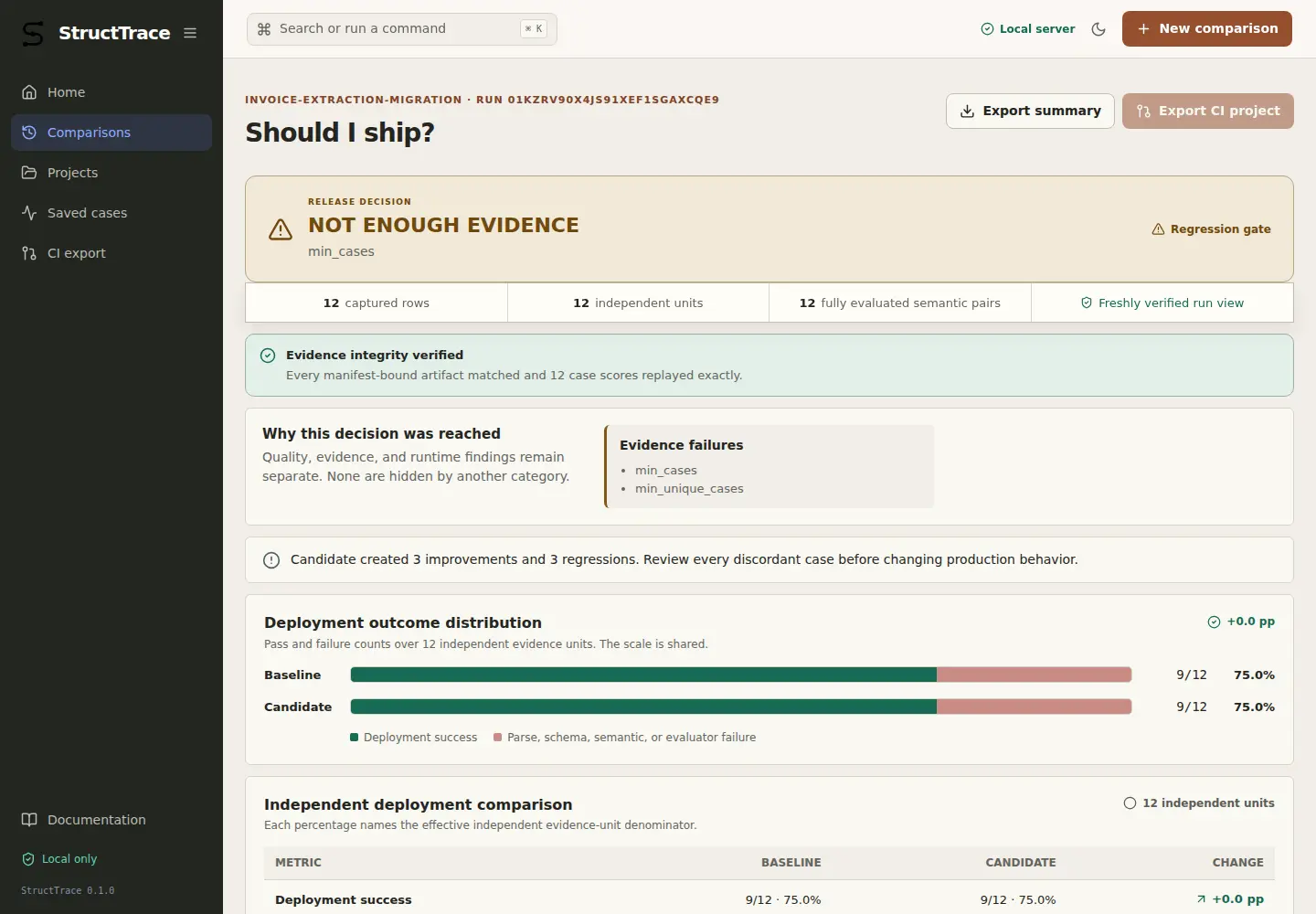
Small, duplicated, conflicted, or incompletely evaluated datasets cannot silently authorize a release.
Reports, manifests, source hashes, outcome rows, and replay receipts remain inspectable outside the UI.
Constrained-decoding experiments motivated the product. Cross-family replication also showed why StructTrace measures instead of prescribing one universal optimization.
| Gate | Cases | Control | Treatment | Paired effect |
|---|---|---|---|---|
| Corrected Qwen representation | 49 | 18/49 | 24/49 | +12.2 pp |
| Canonical Llama replication | 150 | 92/150 | 82/150 | -6.7 pp |
| Executable tool-call pilot | 30 | 26/30 | 24/30 | -6.7 pp |
The estimates use different models and tasks. They are displayed as a research chain, not one combined effect.
Use the bundled invoice comparison, inspect the three regressions and three improvements, then bring one of your own stable-contract migrations.